SupportManual › Estimate Generation

Estimate Generation

How the platform automatically generates financial forecasts and how to work with them.

Estimate generation is a component that creates financial forecasts for a company model. The power of the Valuatum system lies in automatic estimate generation combined with the ability to adjust those estimates freely. It is essential to generate estimates before creating a report — automatic estimates provide a good starting point for more accurate manual inputs.

Estimate generation uses historical financial figures to create forecasts for following years based on predetermined rules. The most important estimates are Net sales growth and EBIT-%. The rules can be modified in the superadmin page. You can find a video tutorial on using the valuation tool on our Platform Tutorials page.

Section 1

Net sales growth in estimate generation

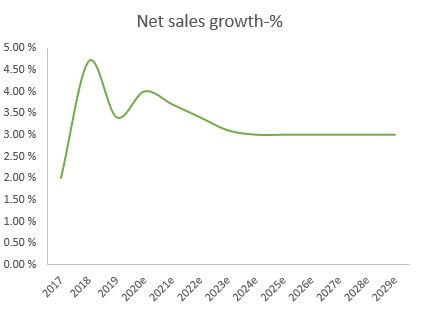
Net sales growth-% is arguably the most important estimate. It is calculated by averaging growth from previous years, then gradually converging toward 3% — a sensible upper bound for long-term growth — during estimate years.
Case 1 — Moderate growth

For a company with reasonably positive net sales growth, the first estimate years will show positive growth that gradually converges to a more conservative long-term rate.

Estimate generation for company experiencing moderate growth
Case 1: Estimate generation for company with moderate historical growth

Case 2 — High and volatile growth

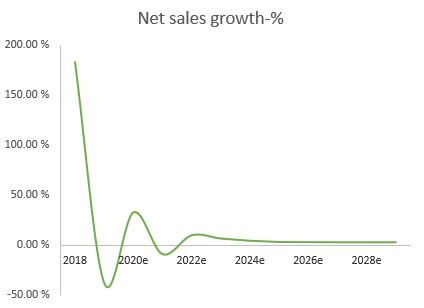
A company with very high but also volatile growth including negative years. Averaging past growth prevents unreasonably high estimates, and the estimate automatically converges toward a realistic long-term rate.

Estimate generation for company experiencing rapid growth
Case 2: Estimate generation for company with high historical growth

Case 3 — Declining or negative growth

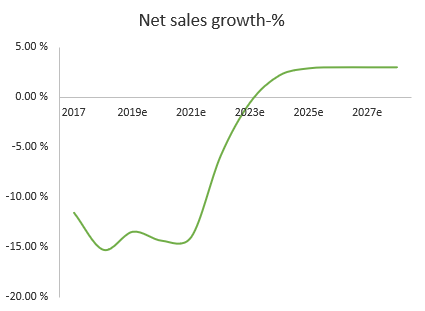
A company that has struggled to grow. Following standard valuation practice, the estimated growth rate still converges to a reasonable long-term level.

Estimate generation for company experiencing negative net sales growth
Case 3: Estimate generation for company with negative historical growth

Section 2

EBIT and ROI in estimate generation

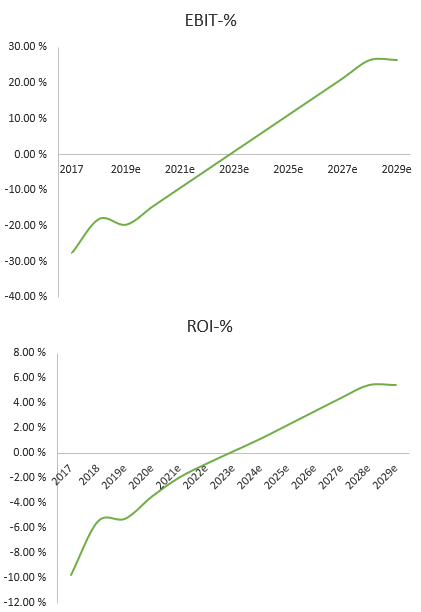
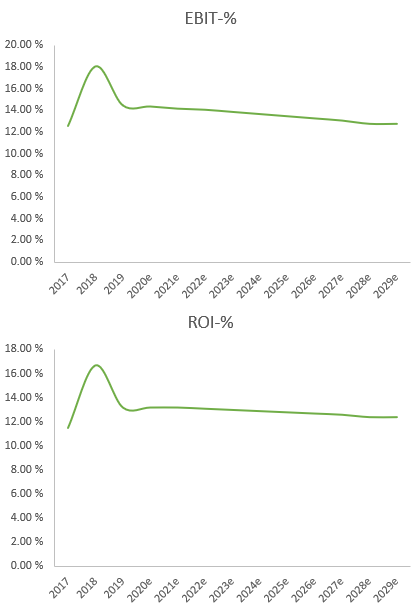
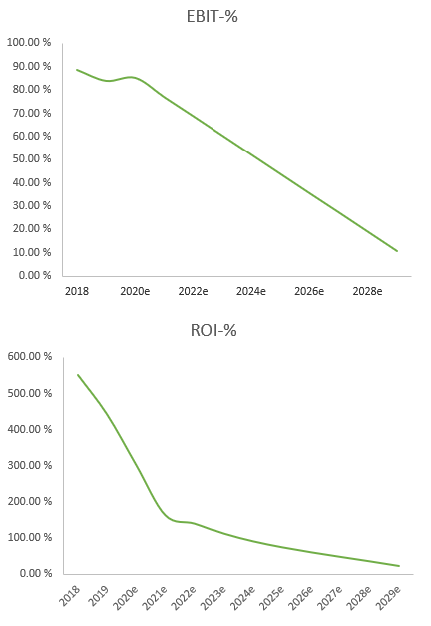
EBIT-% is estimated from the average of historical values, while simultaneously targeting a reasonable ROI-% at which the business would be sensible to continue operating. The EBIT-% converges toward this target level during the estimate period.
Case 1 — Highly profitable company

A company with strong historical profitability. The historical average influences the first estimate years, then the percentage gradually converges to a level where ROI-% is on a reasonable long-term basis.

Automatic estimates for highly profitable company
Case 1: EBIT/ROI estimates for highly profitable company

Case 2 — Extremely profitable company

A company with extraordinary profitability that cannot be sustained long-term. The profitability estimates decline to a more economically reasonable level automatically.

Automatic estimates for extremely profitable company
Case 2: EBIT/ROI estimates for company with unsustainable profitability

Case 3 — Unprofitable company

A company currently making losses. The automatic EBIT-% estimation converges to the ROI-% level at which the business would be viable to continue operating.

Automatic estimates for unprofitable company
Case 3: EBIT/ROI estimates for unprofitable company

Section 3

Other items

Depreciation, financial items, and balance sheet items are mainly estimated by calculating the ratio to some other item. For example, it is reasonable to assume that working capital items scale with net sales, since those are related to the scale of the business.

For payout ratio, the latest historical figure is used. The same applies to depreciation: the depreciation percentage is calculated from the latest year and applied to estimate year assets.